Day 20 A.M. & P.M.

Markings.

WF D20 Lupine and Paintbrush 2.jpg

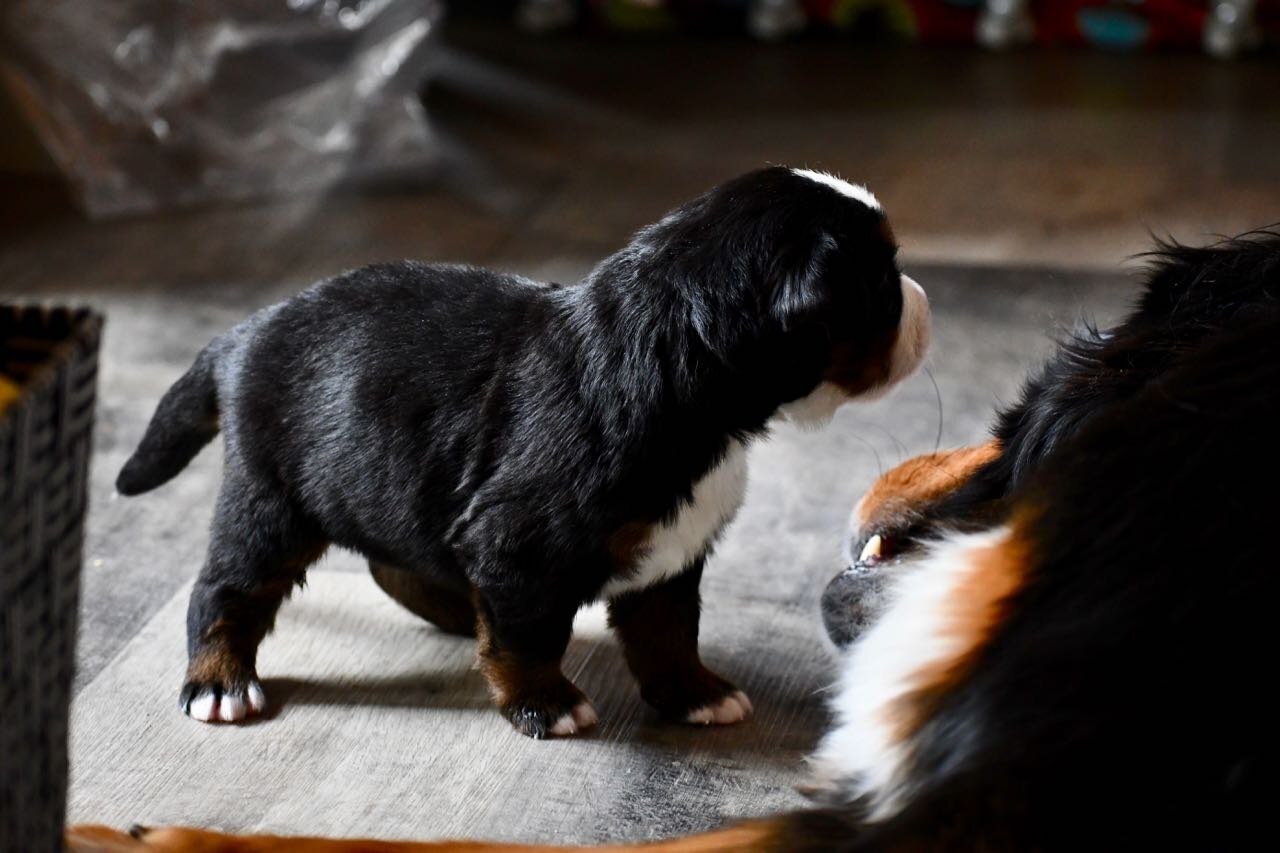
Very few Berners have “perfect” markings.

Although Lupine appears to be correctly marked with her white blaze and muzzle, four white feet and white tail tip, she actually has a marking flaw — it is just not as noticeable as Paintbrush, who does not have much white on the left side of his muzzle.

Note below how Lupine’s white extends past the corner of her mouth on her right side.

WF D20 Lupine and Paintbrush 3.jpg

You can really see it in the photo below — it is called a Swiss Smile.

The small bit of white on the back of her neck is called a Swiss Kiss — that will all but go away as she grows. Both Mariposa and Lupine have those Swiss Kisses.

WF D20 Lupine and Paintbrush 4.jpg

White on a puppy — or lack of white — creates a certain illusion. For example, more white on one paw than the other can actually make the white paw look bigger. White faces seem to make the heads seem bigger — although, to be fair, Lupine has a big head!

WF D20 Lupine and Paintbrush 5.jpg

Things went great overnight in the new Wildflower Place. Dear Husband again stayed up all night — I do not know how people raise litters without a night shift person as it makes ALL the difference. I wake up mostly rested, and both Daisy and the puppies get fed well overnight.

But we will now start to transition back to a more normal sleep routine, which involves Dear Husband staying up to his usual 1 — 2 a.m. (he is naturally a Night Owl ) and me getting up between 4 — 5 a.m., which is normal for me.

This means there is just a short gap where Daisy and the puppies do not have an awake person with them — just close by. Since they will be three weeks old tomorrow (how did THAT happen?!) and they are safely in the escape-proof Wildflower Place (aka Dining Room), I think we are all ready.

This is Mallow — so cute.

WF D20 Mallow.jpg

Back to markings — this is Mariposa and Lupine. If you look at the next two photos, you can see that both puppies have rust to the corner of their mouths; Lupine’s Swiss Smile is only on the right side of her face.

WF D20 Mariposa and Lupine 1.jpg
WF D20 Mariposa and Lupine 2.jpg

Larkspur is a nicely marked puppy but again — not perfect. Look at the difference between his muzzle white and the two girls above.

WF D20 Larkspur.jpg

Sometimes I take photos and forget to also take one with the collar so I know who it is — like this one.

WF D20 Larkspur (1).jpg

Puppy Posse.

WF D20 Puppy Posse 2.jpg

Definitely Larkspur.

WF D20 Larkspur (2).jpg

The Milk Bar is one big party all the time.

WF D20 Nursing Puppies.jpg

Sage has lovely face and head markings but will have dark feet and a four-hair tail tip.

WF D20 Sage (1).jpg

Bottom line — those who want perfect markings on a Berner should look HERE.

For the rest of us — who embrace dogs and people with imperfections — we have the practically perfect Wildflowers.

WF D20 all nine.jpg

Video HERE.

EVENING: PHOTOS FROM THE DAY

WF D20 posse.jpg
WF D20 posse 2.jpg

So much toothless chomping going on around here.

WF D20 Larkspur being eaten.jpg
WF D20  Mallow.jpg
WF D20 Bob.jpg
WF D20  Daisy and pups.jpg
WF D20 Karma andpups.jpg
Clover

Clover

We created a nursing alcove so that Daisy can still do shift nursing outside of the puppies’ bedroom/playroom. This is all nine!

WF D20  Nursing alcove.jpg

The paws — love!

WF D20 paws.jpg
Sage

Sage

WF D20 Chomp.jpg
WF D20  another chomp.jpg

If you watched the video you will know that we set up the play structure that Lori sent us for our last litter. They are a perfect age for this.

WF D20 Clarkia.jpg

All of the puppies interacted with the structure with no concerns or issues — it was awesome. It won’t stay in their space all the time — novelty is important and so it will come and go, and the things that hang will change as well.

Mariposa

Mariposa

Good Night, Friends!

Day 19 A.M.

The day started, as usual, with the outside-the-box nursing — these session have stretched out to a couple of hours. They nurse and play a bit and sleep and nurse some more, and Daisy seems perfectly happy with this arrangement.

WF D19 Daisy and pups.jpg

Novel today — a box. That is Mariposa.

WF D19 Mariposa on box.jpg

The Wildflowers LOVE the floor chair — as do I. This is Sage.

WF D19 floor chair Sage.jpg

Mariposa.

WF D19 Mariposa.jpg

Larkspur upside down.

WF D19 Larkspur.jpg

I did a Zoom session while they enjoyed themselves and by the end, it looked like this…

WF D19 All nine.jpg

I weighed them all and then back to the whelping box. Maybe if Sage spent less time on the floor chair, he would not have lost his title — the new Heavyweight Champion of the Whelping Box is Lupine at 3.52 pounds! Yep — she a wee bit round. That is her on top.

WF D19 Lupine from back.jpg

Do not let these innocent faces fool you — the puppies have been plotting. They consulted with Bob and devised their plan…

WF D19  Puppy Posse.jpg

Implementation of the plan commenced promptly…

WF D19 Larspur escape.jpg

They are done with the whelping box and want OUT!

WF D19 escape.jpg

I draped the blanket to perhaps discourage climbing and to add a soft landing on the other side. Let’s just say they are not getting 10’s for their dismounts.

WF D19 Lupine escape.jpg

Back to plotting.

WF D19 plotting puppies.jpg

However, we listen in responsive ways to puppy protesters and so today is moving day! No more whelping box for the Wildflowers — they are ready to transplant.

Video and photos later — in the meantime, have a Happy Sunday!

Video HERE

EVENING: PHOTOS FROM THE DAY

Clarkia

Clarkia

Puppy Posse

Puppy Posse

WF D19 larkspur (1).jpg
Sage — remember eyes are blue at this point.

Sage — remember eyes are blue at this point.

Buttercup

Buttercup

Paintbrush

Paintbrush

Daisy and Paintbrush — happy in the new place.

Daisy and Paintbrush — happy in the new place.

Daisy with Clarkia and Mallow

Daisy with Clarkia and Mallow

The move went well — puppies were a bit anxious about all the space at first but with Daisy hanging with them and all the familiar smells and things, they adjusted quickly. We will be adding FUN to the space tomorrow!

Good Night, Friends!

Day 18 A.M.

I got up extra early today to relieve Dear Husband, who continues to stay up overnight with the Wildflowers. This 24-hour coverage means that Daisy receives meals about every 2 - 3 hours around the clock, and the puppies are fed on a fairly regular schedule.

Lactation is a big priority here — and for excellent reasons. Nine of them, in fact.

WF D18  all nine.jpg

I continue to explore what is optimal for babies, and have spent the past few hours researching and reading professional, peer-reviewed articles from the past ten years in the areas of formula vs. breast fed, effects of early weaning, and so on; I list just a few of the articles I cite and/or read below.

I am mindful that none of us can always do “optimal” — we are imperfect humans living in an imperfect world. This reality, however, is not an excuse to throw up our hands and be a Slacker.

Rather, we need to continually aim for optimal — as Peale said, “Shoot for the moon. Even if you miss, you'll land among the stars.”

Larkspur — with ears!

Larkspur — with ears!

I hope it is not news to anyone that "human milk … is considered the gold standard for feeding infants” (Moukarzel et al., 2018, p. 1). Not for puppies of course! Dog milk is the gold standard for feeding puppies.

WF D18 Madhouse.jpg

The amount of research into the benefits of an extended period of only breast feeding are both staggering and not limited to physical health. Moukarzel et al. (2018) noted that “suboptimal provision of nutrients during early postnatal development may have lasting consequences on the brain…” (p. 1).

Sub-optimal = Less than optimal.

Early weaning in rat pups — early by just three days! — “caused lower body weight, length, VFM, total body fat, hypoglycaemia and hypoinsulinaemia, all changes linked to malnutrition status” (Da Silva Lima et al., 2011, p. 1409).

Early weaning = Malnutrition = Less than optimal.

Further, “the disruption of mother–infant bonding in the later lactating period, such as early weaning … greatly affected the infant's neurobehavioral development” (Mogi, K., Nagasawa, M., & Kikusui, T., 2011, p. 1236).

Early weaning = Affected development = Less than optimal.

ACK!

All this reading is making me even more strident about the importance of lactation, delayed weaning, and the dangers of supplementing puppies in any but the most urgent situations.

Breast is best — it is our job to make it work.

Breast milk = Optimal!

WF D18 Daisy nursing.jpg

Another reason for being committed to making lactation work for puppies is the options for replacement and/or supplementation are so so not optimal.

Consider that formula for humans is carefully and extensively studied, and even though that is true it remains inferior nutrition AND more is being learned all the time. For example, researchers have recently identified the importance of Milk Fat Globule Membrane and as a result, human infant formulas have been adjusted.

Larkspur and Clover

Larkspur and Clover

There is zero evidence that puppy formulas — homemade or commercial — are studied and developed with the careful attention that human infant formulas are — and again, human infant formulas — even though very, very well-researched and developed — are inferior to breast milk.

What that means to me is supplementing puppies with any formula is just a bad idea if it can be avoided, and if I ever had to supplement a puppy I would not use a homemade formula.

There is just no possible way a homemade formula has been studied enough to be considered adequate; reading about what goes into human infant formula development has convinced me it is much more complicated (and important) than one might think.

Mallow and Sage

Mallow and Sage

I know — people are thinking, “I have used goat’s milk for puppies for twenty years and …” Great — I wonder how much better it might have been if those puppies had been fed in an optimal way — and there is simply no way to know.

Heck — I wonder how much better my health would be right now had my mother breast fed me!

13268154_1289856927695975_6011987723895076090_o.jpg

As my dad says, “we can’t change what we had for breakfast.” In this discussion, we can take that very literally!

We can, however, plan for a better lunch and dinner.

EVENING: PHOTOS FROM THE DAY

LUPINE

LUPINE

CLARKIA

CLARKIA

SAGE

SAGE

LARKSPUR

LARKSPUR

MALLOW AND PAINTBRUSH

MALLOW AND PAINTBRUSH

You’re welcome

You’re welcome

LUPINE AND DAISY

LUPINE AND DAISY

rePete the Cat visits the Wildflowers

rePete the Cat visits the Wildflowers

CLOVER

CLOVER

PAINTBRUSH - remember that puppy eyes start blue

PAINTBRUSH - remember that puppy eyes start blue

Daisy and Buttercup

Daisy and Buttercup

I hope the photos convey what I see throughout the day — puppies who are thriving because they have a devoted, kind, attentive mother in Daisy. If maternal care is the ticket to well-adjusted puppies, the Wildflowers are going to do some serious blooming.

Good Night, Friends.

Work Cited (and just a couple of examples of some that I reviewed)

Aguirre‐Benítez, E., Porras, M., Parra, L., González‐Ríos, J., Garduño‐Torres, D., Albores‐García, D., . . . Hernández‐Falcón, J. (2017). Disruption of behavior and brain metabolism in artificially reared rats. Developmental Neurobiology, 77(12), 1413-1429.

Da Silva Lima, N., Gaspar de Moura, E., Cottini Fonseca Passos, M., Firmino Nogueira Neto, J., Martha Reis, A., De Oliveira, E., & Cristina Lisboa, P. (2011). Early weaning causes undernutrition for a short period and programmes some metabolic syndrome components and leptin resistance in adult rat offspring. British Journal of Nutrition, 105(9), 1405-1413.

Mogi, K., Nagasawa, M., & Kikusui, T. (2011). Developmental consequences and biological significance of mother–infant bonding. Progress in Neuropsychopharmacology & Biological Psychiatry, 35(5), 1232-1241.

Moukarzel, S., Dyer, R. A., Garcia, C., Wiedeman, A. M., Boyce, G., Weinberg, J., . . . Innis, S. M. (2018). Milk fat globule membrane supplementation in formula-fed rat pups improves reflex development and may alter brain lipid composition. Scientific Reports, 8(1), 15277. doi:http://dx.doi.org.weblib.lib.umt.edu:8080/10.1038/s41598-018-33603-8